

A Premier B2B Part Search
Vishay 53511102 Multi Turn Wirewound Potentiometer
The Vishay Spectrol 535 series multi-turn wirewound potentiometer is a precision instrument designed for applications requiring fine and accurate control. Featuring a robust construction and multiple turns, this potentiometer delivers high torque and excellent resolution. It's ideal for industrial machinery, automation systems, and other applications where precise adjustments are critical. Customization options such as shaft extensions, concentric shafts, and special markings cater to diverse integration needs. The potentiometer's robust design ensures reliable performance even in challenging environments, making it a dependable choice for demanding applications.
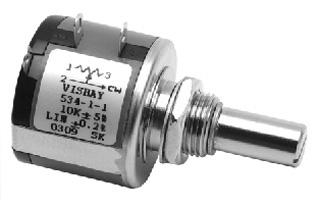
Vishay 53511102 Multi Turn Wirewound Potentiometer Specifications:
- Sensor type: ROTATIONAL, multi turn wirewound
- Output type: Output byturrets
- Market appliance: Industrial
- Dimensions: 7/8" (22.2 mm)
- Bushing and servo mount designs: available
- Resistance range - standard values (Model 533): 50 to 20 k
- Resistance range - standard values (Model 534): 100 to 100 k
- Resistance range - standard values (Model 535): 50 to 50 k
- Capability range (Model 533): 5 to 60 k
- Capability range (Model 534): 10 to 200 k
- Capability range (Model 535): 5 to 100 k
- Standard tolerance: ± 5%
- Linearity (independent): ± 0.25 %
- Noise: 100ENR
- Rotation (electrical and mechanical) (Model 533): 1080°+10°-0°
- Rotation (electrical and mechanical) (Model 534): 3600°+10°-0°
- Rotation (electrical and mechanical) (Model 535): 1800°+10°-0°
- Power rating (at 70 °C) (Model 533): 1.0 W
- Power rating (at 70 °C) (Model 534): 2.0 W
- Power rating (at 70 °C) (Model 535): 1.5 W
- Insulation resistance: 1000 Mminimum 500 VDC
- Dielectric strength: 1000 VRMSminimum 60 Hz
- Absolute minimum resistance: Not to exceed linearityx total resistance or 1,whichever isgreater
- Temperature coefficient: 20ppm/°C(standard values,wire only)
- End voltage: 0.25%of total applied voltage,maximum
- Phasing: CCW endpoints - section 2phased to section 1 within ± 2°
- Taps: Center taponly
- Marking: Unit identification, Manufacturer’s name and model number, resistance value and tolerance, linearity specification date code and terminal identification
- Resistance values (Model 533): 50, 100, 200, 500, 1K, 2K, 5K, 10K, 20K
- Resistance values (Model 534): 100, 200, 500, 1K, 2K, 5K, 10K, 20K, 50K, 100K
- Resistance values (Model 535): 50, 100, 200, 500, 1K, 2K, 5K, 10K, 20K, 50K
- Style: Bushing or Servo
- Gangs: 1 or 2
- Ohmic Value Gangs No1: 470= 47, 222= 2.200, 103= 10 k
- Ohmic Value Gangs No2: For ohmic value range see electrical specification
- Tolerance on Ohmic Value: J= ± 5 %, F= ± 1 %
- Linearity: C= ± 0.25 %, D= ± 0.1 %, L= ± 0.2 %, E= ± 0.05 %
- Special Request: Special code xxxx
Buy the 535-11102 VISHAY Multi Turn Wirewound Potentiometer | myMectronic
Purchase the Vishay 535-11102 Multi Turn Wirewound Potentiometer securely and reliably online.
Buy Now
Frequently Asked Questions
Where can I buy Vishay 53511102?
You can click on the BUY or RFQ button to purchase 53511102 from an authorized Vishay distributor.
How do I troubleshoot issues or seek technical support for part 53511102?
You can download the 53511102 datasheet or visit the Vishay website for support.
Who is the manufacturer of 53511102?
Vishay